
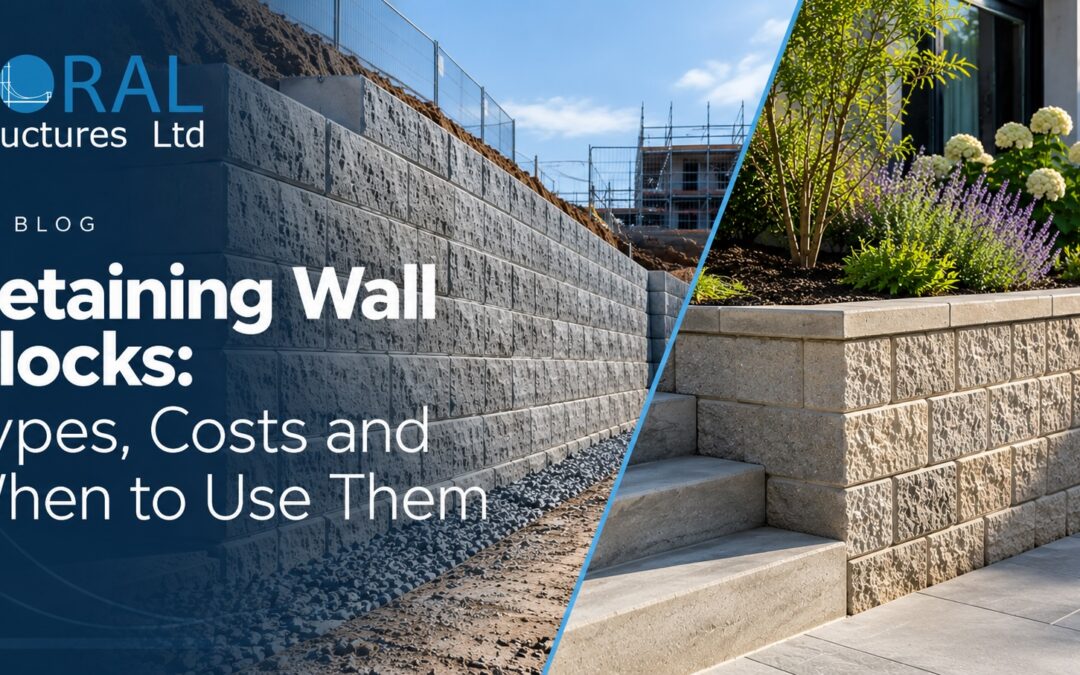
Retaining wall blocks are the first thing most homeowners search for when a sloped garden or a drop in level needs holding back – they’re familiar, they’re widely stocked and a low wall built from them looks like a manageable weekend job. This guide explains the block types on the UK market, what they cost, how tall they can safely go and, just as importantly, when a block wall stops being the right answer and an engineered reinforced concrete wall takes over.
In Brief
- Retaining wall blocks are precast concrete or interlocking units laid without mortar to build a retaining structure and they’re the standard choice for garden walls up to around 1 metre.
- The 3 main types are interlocking dry-stack blocks, mortared concrete masonry blocks and large precast “lego” blocks used on commercial sites.
- UK prices in 2026 typically run £60 to £150 per square metre supplied for interlocking blocks, plus installation.
- Most manufacturers rate their standard interlocking blocks for gravity walls up to 1 metre to 1.2 metres, beyond which a reinforced or engineered design is needed.
- Above 1 metre or with any surcharge above the wall such as a driveway or a building, a block wall needs proper drainage design and often geogrid reinforcement so it’s engineered rather than DIY.
- Block walls have a design life of roughly 25 to 50 years, well short of the 60 to 120 years a reinforced concrete wall achieves.
- Where a wall needs to retain over 1.2 metres, carry a load above it or sit close to a boundary, a reinforced concrete retaining wall is the safer and often cheaper long-term option once you account for drainage failures and rebuilds.
What Are Retaining Wall Blocks?
Retaining wall blocks are precast concrete units, either dry-stacked and interlocking or laid and mortared, that build up in courses to hold back sloped or raised ground. They rely on their own weight and shape to resist the pressure of the soil behind them, which is why engineers call a block wall built this way a gravity wall.
Most modern interlocking blocks use a lip, pin or lug system on the underside that locks each course into the one below and many are tapered slightly backward so the finished wall leans very slightly into the bank it’s retaining – a small but important detail called “batter” that adds real stability. Behind the blocks sits a layer of free-draining aggregate and, on anything over about 600mm, a geotextile membrane to stop soil washing into the drainage layer and clogging it.
Types of Retaining Wall Blocks
The 3 main types of retaining wall block on the UK market are interlocking dry-stack blocks, mortared concrete masonry blocks and large precast “lego” blocks used mainly on commercial and civils sites.
| Block type | Typical height limit | Installation | Best for | 2026 cost (per m², UK) |
|---|---|---|---|---|
| Interlocking dry-stack | 1m-1.2m without engineering | DIY-friendly, no mortar | Garden and domestic retaining | £60-£150 supplied |
| Mortared concrete block | Up to 1.5m with reinforcement | Skilled trade, bricklaying | Boundary and garden walls needing a finished face | £90-£180 supplied and laid |
| Precast “lego” blocks | 2m-6m+ | Machine-placed, needs an excavator | Commercial yards, civils, agricultural | £150-£300+ per m³ |
Interlocking blocks are the ones you’ll see stacked at builders’ merchants and garden centres, sold under trade names most UK homeowners will recognise. They’re the right choice for a straightforward garden wall and they’re genuinely DIY-friendly up to their rated height. Mortared masonry blocks give a more traditional finish and can be rendered, clad or left fair-faced. The large precast “lego” blocks are a different product entirely, sized for a telehandler rather than a wheelbarrow and they’re used where a tall wall needs to go up fast with minimal groundworks.
How Much Do Retaining Wall Blocks Cost in the UK?
Retaining wall blocks typically cost £60 to £150 per square metre supplied in the UK in 2026, with installation adding roughly the same again for a professionally built wall.
| Item | Typical 2026 cost (UK) | Notes |
|---|---|---|
| Interlocking blocks, supplied | £60-£150 per m² | Depends on finish and manufacturer |
| Installation labour | £50-£120 per m² | Excavation, base, laying, backfill |
| Drainage layer (gravel + membrane) | £15-£30 per m² | Essential, don’t skip it |
| Geogrid reinforcement (over 600mm) | £10-£25 per m² | Needed as height increases |
| Total installed, straightforward garden wall | £150-£300 per m² | Up to around 1m retained height |
A typical 10 metre run of 800mm-high garden wall therefore lands somewhere around £1,500 to £3,000 fully installed, drainage included. Costs climb quickly past 1 metre because geogrid, deeper foundations and often planning or engineering sign-off all come into play, which is exactly the point at which it’s worth comparing against a retaining wall cost guide for a reinforced concrete alternative before committing.
Where to Buy Retaining Wall Blocks
Retaining wall blocks are stocked by builders’ merchants, landscaping suppliers and larger DIY chains and it’s worth buying from a supplier who can also advise on drainage and geogrid rather than blocks alone. Ask for the manufacturer’s technical data sheet before you order – it states the maximum retained height for a plain gravity installation and the point at which reinforcement becomes mandatory. If a supplier can’t produce that sheet, that’s a sign to look elsewhere, because the height limit is the single most important number on the whole job.
When a Block Wall Isn’t the Right Answer
A block wall stops being suitable once the retained height goes past about 1.2 metres, once there’s a load above it such as a driveway, patio or building or once the ground behind it is saturated for long periods. In all 3 cases, the pressure behind the wall is higher than a gravity block system is designed to resist and pushing blocks past their rated height is one of the most common causes of retaining wall failure we’re called out to in Bristol and Bath.
The honest comparison: a block wall wins on cost and speed for a low garden retaining job however, a reinforced concrete wall wins on everything else once height, load or longevity matter. RC walls are designed to BS EN 1997 (Eurocode 7), use continuous steel reinforcement rather than gravity alone and are built with engineered drainage – weep holes, a granular drainage zone and a perimeter drain – designed in from the outset rather than added as an afterthought. For a full comparison of wall types, see our reinforced concrete retaining walls guide.
When to Call a Reinforced Concrete Specialist
Call a specialist rather than buying blocks off the shelf once the wall is over 1 metre, carries any load above it or sits close to a boundary or a structure.
- DIY or landscaper: garden block walls under 600mm-800mm, no load above, plenty of room behind the wall to dig and backfill properly.
- General builder: mortared block walls up to about 1 metre where the ground is stable and there’s no surcharge.
- Reinforced concrete specialist: anything over 1 metre, any wall with a driveway, patio or building above it and any site where access is tight or the ground is poor.
Coral Structures is a family-run reinforced concrete contractor serving Bristol, Bath, Somerset and the South West. Where a block wall genuinely is the right call we’ll tell you honestly and where it isn’t, our retaining wall contractors team builds the engineered alternative properly the first time, with the design, drainage and reinforcement sized to last.
Frequently Asked Questions
Most standard interlocking retaining wall blocks are rated for gravity walls up to 1 metre to 1.2 metres, confirmed against the manufacturer’s own data sheet. Beyond that height or with any surcharge load above the wall, the design needs geogrid reinforcement or an engineered structure such as reinforced concrete and it should be signed off by an engineer rather than built on manufacturer guidance alone.
Usually not for a garden wall under 1 metre next to a highway or 2 metres elsewhere, which covers most domestic block walls. Planning permission is more often needed once height increases, in a conservation area or on a listed property. Building Regulations don’t directly cover garden retaining walls, but any wall over 1 metre or supporting a structure should still be engineer-designed.
Yes, within their rated height. Interlocking blocks are a genuinely solid, DIY-friendly option for garden retaining up to around 1 metre, provided drainage is installed behind them and the base course sits on a properly compacted foundation. Most failures happen because drainage was skipped or the wall was built taller than the block’s rated limit, not because the block itself was faulty.
Block walls rely on their own weight to resist the soil behind them, known as a gravity wall and they’re typically limited to around 1 metre to 1.2 metres. Reinforced concrete walls use steel reinforcement bonded into the concrete, which lets them retain much greater heights safely, carry loads such as driveways above and last 60 to 120 years against a block wall’s 25 to 50.
Concrete retaining wall blocks typically last 25 to 50 years when built with proper drainage and not overloaded beyond their rated height. Lifespan drops sharply if drainage was never installed or if the wall is retaining more height or load than it was designed for, which is the most common reason a block wall needs replacing early.
Yes – most modern interlocking retaining wall blocks are designed to be dry-stacked without mortar, using a lip or pin system on the underside of each block to lock it into the course below. This is standard practice in the UK and, done correctly with a compacted base and proper drainage, is a stable and long-lasting method for garden retaining walls.
Yes, always. A layer of free-draining aggregate behind the wall, combined with a geotextile membrane and weep holes or a drainage pipe at the base, is essential on any retaining wall block installation. Skipping drainage is the single biggest cause of block wall failure in the UK, because trapped water builds up pressure the wall was never designed to resist.
Talk to a Reinforced Concrete Specialist
Coral Structures is a family-run reinforced concrete contractor with more than 20 years of experience serving Bristol, Bath, Somerset and the South West. Send us your drawings or a description of the site and we’ll come back with an honest answer and a fixed-price quote.